President Richard Nixon established the Minority Business Development Agency (MBDA) to fund and support minority-run businesses, promoting 'Black Capitalism' as a policy response to economic inequality. The agency aimed to address the limited impact of previous affirmative action and government assistance to …
📍Washington, D.C., DC
👤African AmericanCivil rights movement
Read more about this entry
President Richard Nixon established the Minority Business Development Agency (MBDA) to fund and support minority-run businesses, promoting 'Black Capitalism' as a policy response to economic inequality. The agency aimed to address the limited impact of previous affirmative action and government assistance to Black-owned enterprises[2]. This policy reflected a shift toward economic empowerment within the Nixon administration's approach to civil rights[2].
Signed by President Lyndon B. Johnson, this act prohibited racial discrimination in the sale, rental, and financing of most housing units nationwide. It was the first federal law to explicitly address housing discrimination and aimed to dismantle de jure and de facto …
📍Washington, D.C., US
👤Housing & redliningJim Crow
Read more about this entry
Signed by President Lyndon B. Johnson, this act prohibited racial discrimination in the sale, rental, and financing of most housing units nationwide. It was the first federal law to explicitly address housing discrimination and aimed to dismantle de jure and de facto segregation in residential areas. The act was passed in the aftermath of Martin Luther King Jr.'s assassination.
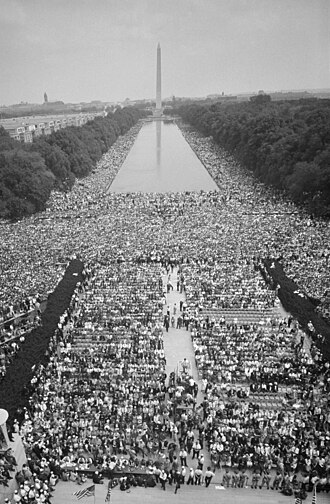
On August 28, 1963, over 250,000 people gathered in Washington, D.C. for the March on Washington, where Martin Luther King Jr. delivered his iconic 'I Have a Dream' speech[2]. The event helped galvanize public support for the Civil Rights Act of 1964 …
📍Washington, D.C., DC
👤Civil rights movementVoting rights
Read more about this entry
On August 28, 1963, over 250,000 people gathered in Washington, D.C. for the March on Washington, where Martin Luther King Jr. delivered his iconic 'I Have a Dream' speech[2]. The event helped galvanize public support for the Civil Rights Act of 1964 and the Voting Rights Act of 1965[5].