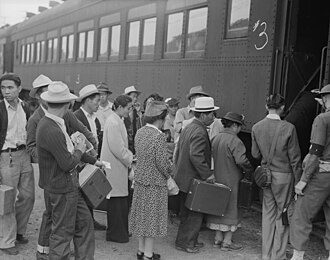
The last Japanese American incarceration camp closed on November 30, 1945, marking the official end of the four-year program that stripped over 120,000 people of freedom and property [2]. While the Roosevelt administration declared the period of 'military necessity' over in December …
📍Pacific Coast, US, US
👤Incarceration & campsJapanese American
Read more about this entry
The last Japanese American incarceration camp closed on November 30, 1945, marking the official end of the four-year program that stripped over 120,000 people of freedom and property [2]. While the Roosevelt administration declared the period of 'military necessity' over in December 1944 allowing returns to the Pacific Coast, the full process of returning to communities took years, and many faced continued resistance [2][13]. President Harry S. Truman signed Executive Order 9742 on June 25, 1946, ordering the liquidation of the War Relocation Authority [14].
On December 17, 1944, the Roosevelt administration rescinded the exclusion orders that had mandated Japanese American removal from the West Coast. Nine of the ten incarceration camps were shut down by the end of 1945. This marked the official end of the …
On December 17, 1944, the Roosevelt administration rescinded the exclusion orders that had mandated Japanese American removal from the West Coast. Nine of the ten incarceration camps were shut down by the end of 1945. This marked the official end of the forced removal policy, though many Japanese Americans faced barriers returning to their homes.
The Bracero Program was initiated in 1942 through agreements between the U.S. and Mexican governments to allow temporary laborers from Mexico to work legally in the United States during World War II[4]. The program guaranteed workers minimum wages, housing, and protection from …
📍Washington, DC, DC
👤Housing & redlining
Read more about this entry
The Bracero Program was initiated in 1942 through agreements between the U.S. and Mexican governments to allow temporary laborers from Mexico to work legally in the United States during World War II[4]. The program guaranteed workers minimum wages, housing, and protection from discrimination, though many faced wage theft, racial discrimination, and abuse by agricultural corporations[2][5]. Over its 22-year duration, more than 4.5 million Mexican workers arrived, primarily for agricultural and railroad work in Texas and California[1][4].