Congress passed the Japanese-American Claims Act of 1948, signed by President Harry Truman, providing partial financial compensation for lost property to Japanese Americans incarcerated during World War II [2][3]. The act allowed internees to submit claims for property losses, though the total …
📍Washington, DC, DC
👤Incarceration & campsJapanese American
Read more about this entry
Congress passed the Japanese-American Claims Act of 1948, signed by President Harry Truman, providing partial financial compensation for lost property to Japanese Americans incarcerated during World War II [2][3]. The act allowed internees to submit claims for property losses, though the total compensation of $38 million was far less than the estimated $400 million in losses [3]. This was the first federal acknowledgment of the injustice of the incarceration and a step toward reparations [2][3].
The Shelley family's fight against a St. Louis racial covenant reached the Supreme Court, which ruled that courts cannot enforce private agreements barring home sales to Black buyers.
📍St. Louis, Missouri, MO
👤African AmericanHousing & redlining
Read more about this entry
The Shelley family's fight against a St. Louis racial covenant reached the Supreme Court, which ruled that courts cannot enforce private agreements barring home sales to Black buyers.
While not a single court case name, the period saw the Home Owners' Loan Corporation (HOLC) and Federal Housing Administration (FHA) systematically embed redlining into national policy through 'Security Maps' that rated Black neighborhoods as hazardous. This policy denied mortgage insurance and …
📍Washington, D.C., DC
👤African AmericanHousing & redliningJim CrowLabor
Read more about this entry
While not a single court case name, the period saw the Home Owners' Loan Corporation (HOLC) and Federal Housing Administration (FHA) systematically embed redlining into national policy through 'Security Maps' that rated Black neighborhoods as hazardous. This policy denied mortgage insurance and credit to Black families, enforcing residential segregation across the North and Midwest. The practice was institutionalized under New Deal-era housing programs.
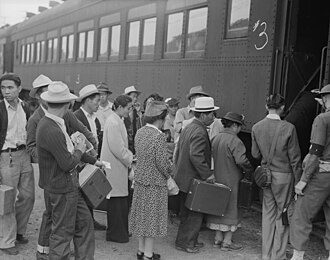
The last Japanese American incarceration camp closed on November 30, 1945, marking the official end of the four-year program that stripped over 120,000 people of freedom and property [2]. While the Roosevelt administration declared the period of 'military necessity' over in December …
📍Pacific Coast, US, US
👤Incarceration & campsJapanese American
Read more about this entry
The last Japanese American incarceration camp closed on November 30, 1945, marking the official end of the four-year program that stripped over 120,000 people of freedom and property [2]. While the Roosevelt administration declared the period of 'military necessity' over in December 1944 allowing returns to the Pacific Coast, the full process of returning to communities took years, and many faced continued resistance [2][13]. President Harry S. Truman signed Executive Order 9742 on June 25, 1946, ordering the liquidation of the War Relocation Authority [14].
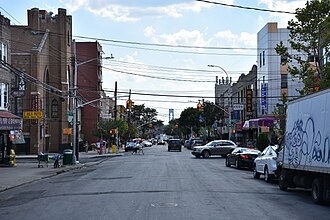
During the 1940s and 1950s, the Home Owners' Loan Corporation (HOLC) produced 'security maps' that systematically denied loans to Black and minority neighborhoods in Brooklyn, enforcing redlining and racial covenants[2]. These practices entrenched segregation and limited economic mobility for Black residents in …
During the 1940s and 1950s, the Home Owners' Loan Corporation (HOLC) produced 'security maps' that systematically denied loans to Black and minority neighborhoods in Brooklyn, enforcing redlining and racial covenants[2]. These practices entrenched segregation and limited economic mobility for Black residents in one of the nation’s largest urban areas.
On December 17, 1944, the Roosevelt administration rescinded the exclusion orders that had mandated Japanese American removal from the West Coast. Nine of the ten incarceration camps were shut down by the end of 1945. This marked the official end of the …
On December 17, 1944, the Roosevelt administration rescinded the exclusion orders that had mandated Japanese American removal from the West Coast. Nine of the ten incarceration camps were shut down by the end of 1945. This marked the official end of the forced removal policy, though many Japanese Americans faced barriers returning to their homes.
The Supreme Court ruled that the "White primary," which excluded Black people from voting in Democratic Party primaries, was unconstitutional[3]. This decision struck down Texas' all-white primary system, a key mechanism of disenfranchisement in the South[3]. It marked a critical step toward …
📍Washington, DC, DC
👤African AmericanVoting rights
Read more about this entry
The Supreme Court ruled that the "White primary," which excluded Black people from voting in Democratic Party primaries, was unconstitutional[3]. This decision struck down Texas' all-white primary system, a key mechanism of disenfranchisement in the South[3]. It marked a critical step toward ending systemic voting barriers predating the 1965 Voting Rights Act[3].
On June 15, 1943, a white mob in Beaumont, Texas, lynched two Black men and smashed Black homes during a three-day pogrom following the alleged rape of a white woman. The violence targeted the entire Black neighborhood, resulting in widespread property destruction …
📍Beaumont, Texas, TX
👤African AmericanRacial violence
Read more about this entry
On June 15, 1943, a white mob in Beaumont, Texas, lynched two Black men and smashed Black homes during a three-day pogrom following the alleged rape of a white woman. The violence targeted the entire Black neighborhood, resulting in widespread property destruction and community terror [12]. No perpetrators were ever convicted, illustrating systemic racial injustice [12].
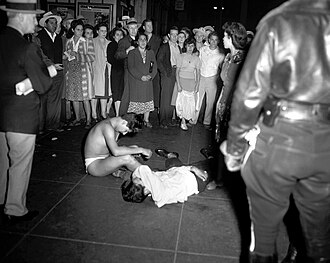
The Zoot Suit Riots were incidents of racial violence against Latinos in Los Angeles that lasted several days in June 1943. White police officers and servicemen targeted Mexican American youths wearing zoot suits, arresting hundreds and beating many without cause. The riots …
📍Los Angeles, California, CA
👤LatinoPolicingRacial violence
Read more about this entry
The Zoot Suit Riots were incidents of racial violence against Latinos in Los Angeles that lasted several days in June 1943. White police officers and servicemen targeted Mexican American youths wearing zoot suits, arresting hundreds and beating many without cause. The riots reflected deep racial tensions and discrimination against Mexican Americans during World War II, particularly in the American West.
The Pittsburgh Courier launched the Double V campaign in February 1942 to advocate for African American rights during World War II, promoting victory abroad against fascism and victory at home against racism. The campaign lobbied for equal military treatment, anti-poll tax legislation, …
📍Philadelphia, PA, PA
👤African AmericanJim CrowRacial violenceVoting rights
Read more about this entry
The Pittsburgh Courier launched the Double V campaign in February 1942 to advocate for African American rights during World War II, promoting victory abroad against fascism and victory at home against racism. The campaign lobbied for equal military treatment, anti-poll tax legislation, criminalization of lynching, and fair employment practices in wartime industries. It increased demand for Executive Order 8802, which banned employment discrimination in defense industries.
Following Executive Order 9066, the forced removal of Japanese Americans from California, western Oregon, western Washington, and southern Arizona began in March 1942, with General John L. DeWitt ordering the relocation of all people of Japanese descent in these areas [4]. Approximately …
Following Executive Order 9066, the forced removal of Japanese Americans from California, western Oregon, western Washington, and southern Arizona began in March 1942, with General John L. DeWitt ordering the relocation of all people of Japanese descent in these areas [4]. Approximately 110,000 to 120,000 people, two-thirds of whom were U.S. citizens, were abandoned their homes and communities and forcibly relocated to War Relocation Authority confinement sites [4][5]. Residents lost an estimated $400 million in property during their incarceration, which lasted an average of two to four years behind barbed wire [3][9].
The Bracero Program was initiated in 1942 through agreements between the U.S. and Mexican governments to allow temporary laborers from Mexico to work legally in the United States during World War II[4]. The program guaranteed workers minimum wages, housing, and protection from …
📍Washington, DC, DC
👤Housing & redlining
Read more about this entry
The Bracero Program was initiated in 1942 through agreements between the U.S. and Mexican governments to allow temporary laborers from Mexico to work legally in the United States during World War II[4]. The program guaranteed workers minimum wages, housing, and protection from discrimination, though many faced wage theft, racial discrimination, and abuse by agricultural corporations[2][5]. Over its 22-year duration, more than 4.5 million Mexican workers arrived, primarily for agricultural and railroad work in Texas and California[1][4].
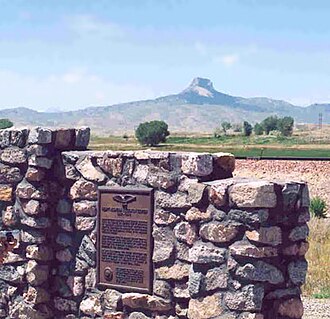
Heart Mountain incarcerated Japanese Americans from the West Coast; draft resisters there later became symbols of protest against unjust incarceration.
📍Heart Mountain, Wyoming, WY
👤Incarceration & campsJapanese AmericanJim Crow
Read more about this entry
Heart Mountain incarcerated Japanese Americans from the West Coast; draft resisters there later became symbols of protest against unjust incarceration.