
S.T.O.R.I.E.S.

Historical Timeline

Sequential Timeline of Racist Incidents, Events, and Sites

1823
1823
institutional court case policy

Johnson v. McIntosh Decision on Indigenous Land Title

In Johnson v. McIntosh, the Supreme Court ruled that Native tribes held only 'occupancy rights' to land, not full title, and that the U.S. government acquired ultimate ownership through discovery and conquest. The decision established the 'doctrine of discovery' as federal common …

Washington, D.C., DC
Indigenous Land & treaties
Read more about this entry
In Johnson v. McIntosh, the Supreme Court ruled that Native tribes held only 'occupancy rights' to land, not full title, and that the U.S. government acquired ultimate ownership through discovery and conquest. The decision established the 'doctrine of discovery' as federal common law, denying Indigenous nations sovereignty over their ancestral territories. It remains a foundational precedent in federal Indian law that continues to affect land claims and tribal rights.

1822
1822
institutional discrimination

Denmark Vesey Slave Revolt Plot

Denmark Vesey, a freed slave, planned the largest slave revolt in U.S. history in Charleston, South Carolina, aiming to free thousands of enslaved people. The rebellion was betrayed before the plan could be carried out, leading to Vesey's execution and the deaths …

Charleston, South Carolina, SC
African American Jim Crow Slavery & emancipation
Read more about this entry
Denmark Vesey, a freed slave, planned the largest slave revolt in U.S. history in Charleston, South Carolina, aiming to free thousands of enslaved people. The rebellion was betrayed before the plan could be carried out, leading to Vesey's execution and the deaths of approximately 35 other Black people. This event intensified racial insecurity and led to stricter slave codes in South Carolina.
1820
1820
institutional legislation

Missouri Compromise and Slavery Expansion

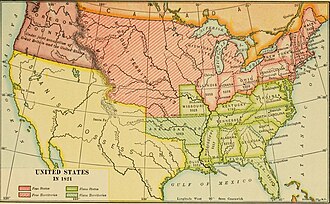
The Missouri Compromise admitted Missouri as a slave state and Maine as a free state, while prohibiting slavery north of the 36°30′ parallel in the Louisiana Territory except for Missouri. This legislation temporarily resolved sectional disputes over slavery expansion but entrenched the …

Washington, DC, DC
Slavery & emancipation
Read more about this entry
The Missouri Compromise admitted Missouri as a slave state and Maine as a free state, while prohibiting slavery north of the 36°30′ parallel in the Louisiana Territory except for Missouri. This legislation temporarily resolved sectional disputes over slavery expansion but entrenched the institution in new territories.